
How to Order Custom Belt Buckles: A Complete B2B Buyer’s Guide
Table of Contents
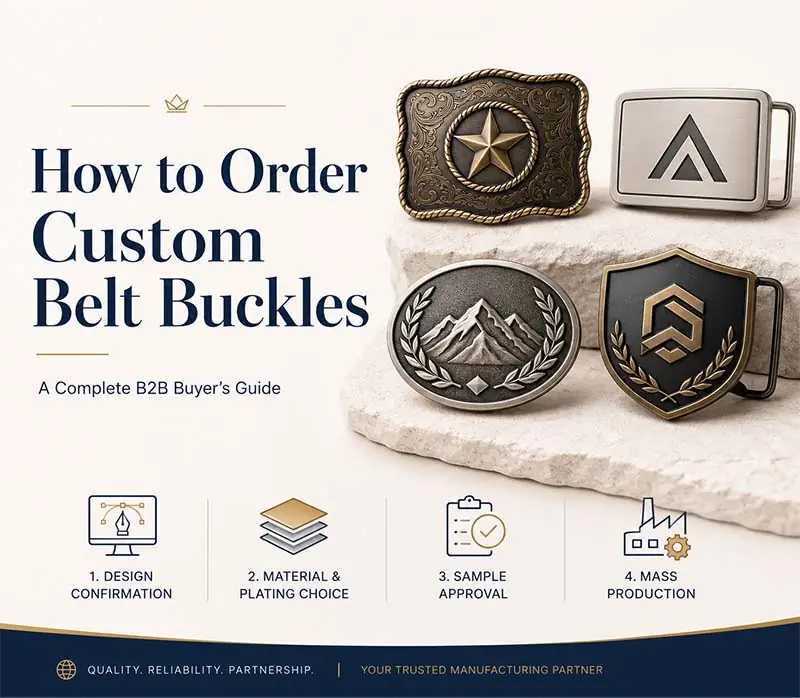
Sourcing custom belt buckles looks straightforward until the quotes come back. Three suppliers, three prices that differ by 200%, three different mold fees — and none of them quoting the same product. One priced die-struck zinc alloy with soft enamel. One priced a printed insert. One forgot to mention that antique plating carries an upcharge.
The problem usually isn’t the supplier. It’s that a belt buckle has more variables than almost any other promotional metal item: casting process, base metal, plating, backside finish, attachment style, packaging. If your RFQ doesn’t lock those down, every factory fills the blanks differently — and you end up comparing quotes that were never comparable.
This guide walks through the ordering process the way it actually runs inside a factory, from spec sheet to shipment. It’s written for distributors, brand owners, event organisers and procurement teams placing repeat B2B orders for custom belt buckles — not for someone buying a single piece.
Who Buys Custom Belt Buckles — and What Each Buyer Needs
Belt buckles serve very different commercial purposes, and the right spec depends on which of these you are. Being clear about your end use changes the material, the process and the packaging recommendation a good factory will give you.
Western wear brands and retailers
The core market for custom western belt buckles. Buyers here care about perceived weight, antique finishing, and detailed 3D relief — rope borders, floral scroll, longhorns, cowboy boots. Retail price points support heavier zinc alloy castings and premium finishes, and the product usually needs to arrive retail-ready with a backer card or box.
Rodeo, equestrian and motorsport event organisers
Trophy buckles are award items first and accessories second. Engraving space for the event name, year, class and winner’s name matters more than fashion detail, and delivery dates are non-negotiable because the event date is fixed. Many organisers order buckles alongside custom medals for lower placings — worth consolidating into one order to share freight and one QC cycle.
Promotional products distributors
Distributors need low MOQs, a documented compliance package and a factory that can hold artwork on file for repeat orders. Because you’re reselling to an end client, your risk is reputational: a buckle that arrives with mismatched plating batches lands on your desk, not the factory’s. Ask about quality control procedures before you ask about price.
Corporations, clubs and associations
Custom logo buckles work as service awards, safety milestones, membership recognition and dealer incentives. The requirement here is brand-exact: Pantone matching, correct logo geometry, and consistency across annual reorders so the 2027 batch matches the 2026 batch. Club and service organisation buckles are a common example of this pattern.
Uniformed services, souvenir retail and licensed merchandise
Security, fire and military-adjacent programmes typically need die-struck detail with hard-wearing plating. Souvenir and tourism buyers — think national flag and city-themed buckles — need bright colour, low unit cost and shelf-ready packaging. Sports and golf programmes often pair buckles with the rest of the golf product range.
Step 1: Build a Spec Sheet Before You Request a Quote
This single step eliminates most sourcing pain. A vague enquiry — “please quote 500 custom belt buckles” — forces the factory to guess, and factories guess in the direction that wins the quote: cheapest process, thinnest casting, basic plating. Then the sample disappoints and you restart.
Send the following with your first enquiry and the quote you get back will be both accurate and comparable across suppliers.
Spec item | What to state in your RFQ |
Quantity & tiers | Ask for pricing at your target quantity plus one tier above and below — e.g. 100 / 300 / 500 pcs. Price breaks are steep at low volumes. |
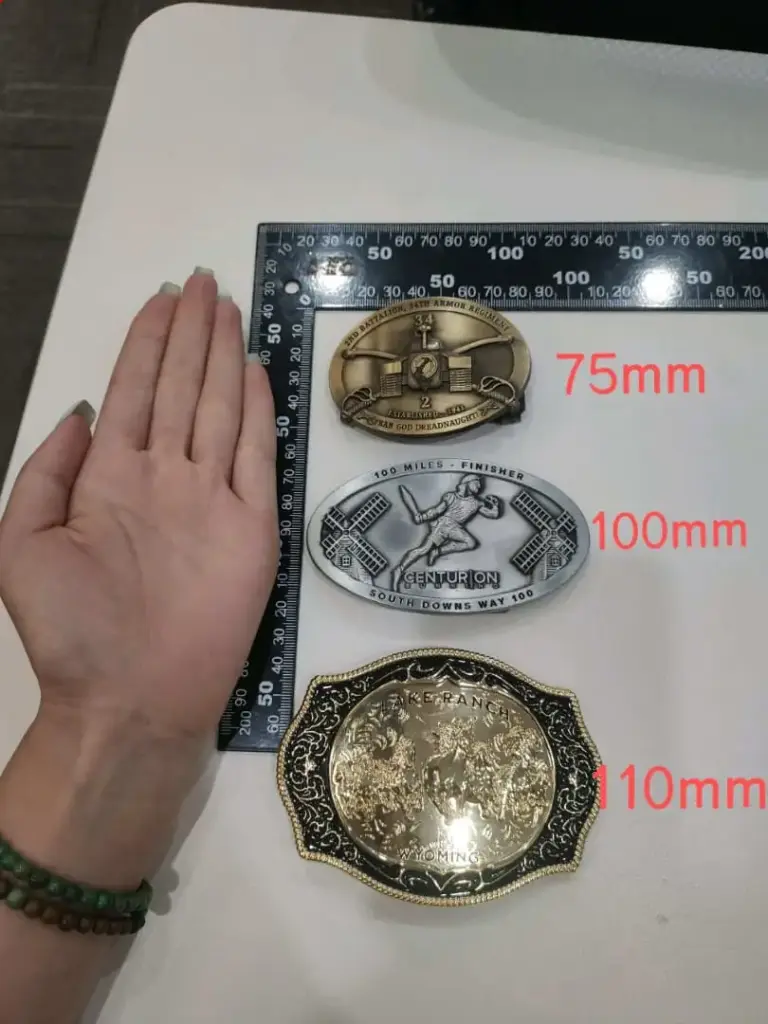
Size | Width × height in mm or inches. Standard western buckles commonly run 75–95 mm wide; oversized trophy buckles go larger. |
Shape | Rectangle, oval, shield, round, or fully custom outline. Custom outlines need their own mold. |
Base metal | Zinc alloy, brass or stainless steel. If unsure, state your target retail price and let the factory advise. |
Process | Die-struck, die-cast 3D, soft enamel, cut-out, printed insert — or describe the look and ask for a recommendation. |
Plating / finish | Name the finish (e.g. antique brass, matt nickel, black nickel) rather than saying “gold-look”. |
Colours | Pantone (PMS) solid coated codes. “Navy” is not a spec; “PMS 289C” is. |
Backside | Blank, raised text, laser-marked text or engraved text — plus the exact copy. |
Attachment | Which loop/bar style, and the belt strap width it must fit (38 mm / 1.5″ is the common standard). |
Packaging | Poly bag, bubble bag, backer card, paper box, velvet box, wooden box or acrylic box. Include barcode or label requirements. |
In-hands date | The date you need stock in your warehouse — not the ship date. Work backwards from the event. |
Compliance | Any required testing: REACH, RoHS, CPSIA, Prop 65, nickel-release. |
If you don’t have artwork yet, that’s fine — a sketch, a reference photo or a written description is enough to start. Flyances provides free design artwork before any commitment, so the visual gets resolved before money moves.
Step 2: Choose the Right Manufacturing Process
Process is the biggest single driver of both appearance and cost. Here is how the main options compare in practice.
Process | Visual result | Relative cost | Best suited to |
Die-struck (stamped) | Crisp raised relief in solid metal, no colour fill. Premium, understated, very durable. | Medium–high | Service awards, uniformed programmes, heritage and club buckles |
3D die-cast | Sculpted multi-level relief with real depth and shadow — the classic western look. | Medium–high | Western and rodeo buckles, trophy buckles, collector pieces |
Soft enamel | Recessed colour fill with visible raised metal lines. Bright, cost-effective, tactile. | Low–medium | Logo buckles, event merchandise, souvenir retail |
Cut-out (openwork) | Sections removed from the plate for a see-through silhouette. Lighter, distinctive. | Medium | Eagle, emblem and crest designs where negative space is the design |
Glitter / rhinestone | Sparkle inlay or stone setting over enamel or plated base. | Medium | Fashion, pageant, country-western retail, women’s lines |
Printed / epoxy-domed | Full-colour printed artwork under a clear dome. Handles gradients and photos. | Low | Complex artwork, tight budgets, short-run promotional campaigns |
Vintage / antiqued | Oxidised finish rubbed back on the high points to emphasise depth. | Add-on | Any 3D or die-struck design needing an aged, heirloom feel |
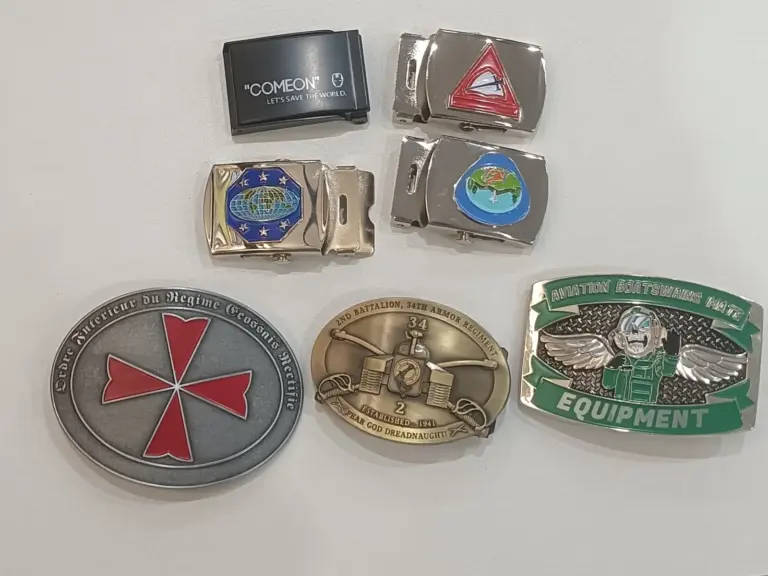
A practical rule: if the design lives in the metal (relief, texture, depth), choose die-struck or 3D casting. If the design lives in the colour (logos, flags, flat graphics), choose soft enamel or printing. Mixing both on one buckle is entirely possible — see the craftwork samples on the buckle product page for how the finishes read side by side.
Step 3: Select Base Metal and Plating
Base metal
Material | Characteristics | Typical use |
Zinc alloy | Excellent for detailed casting, good weight, accepts every plating finish, most cost-efficient at volume. | The default choice for the large majority of custom belt buckles |
Brass | Denser and warmer in tone, superb for die-struck detail, higher raw material cost. | Premium, heritage and die-struck programmes |
Stainless steel | Hardest wearing and corrosion resistant, but limits fine sculpted relief. | Heavy-duty, outdoor and industrial applications |
Plating and finish
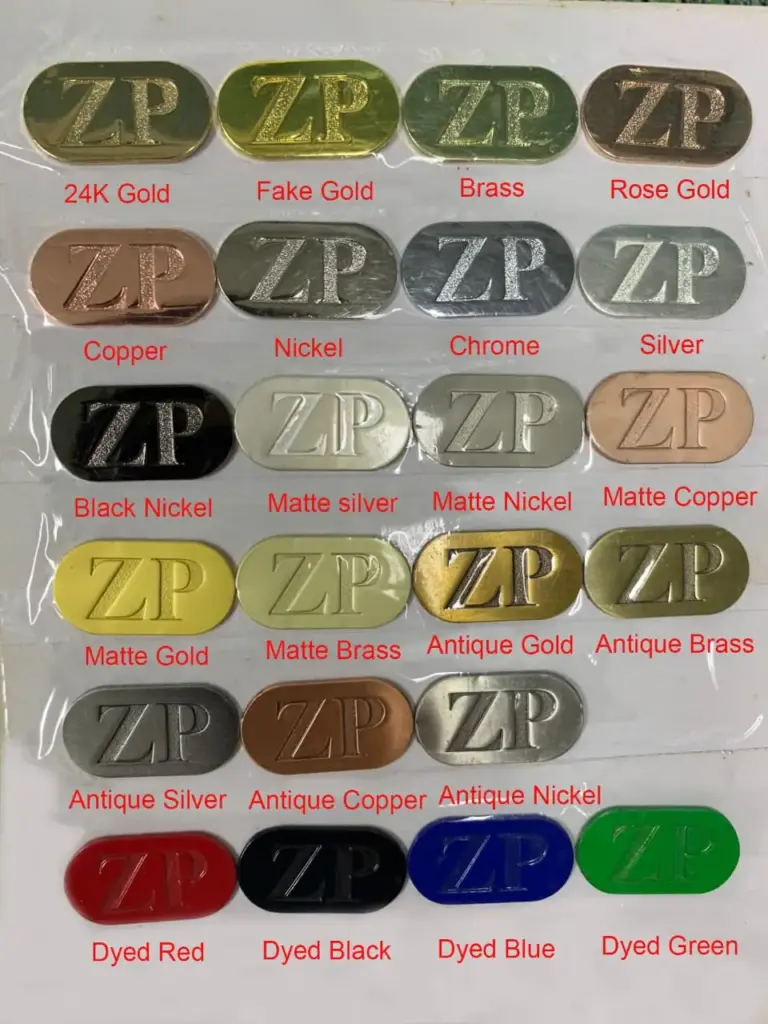
Plating changes the entire personality of the same mold. The standard finish library covers:
- Bright: gold, silver, nickel, brass, copper
- Matt: matt gold, matt silver, matt nickel — lower glare, more contemporary
- Antique: antique brass, antique copper, antique gold, antique silver, antique nickel — the standard for western and heritage designs
- Dark: black nickel and dye black — strong contrast against enamel colour
Two things to confirm in writing before production. First, plating thickness — thin plating on a belt buckle wears through at the edges where it rubs against clothing, and that failure shows up months after delivery. Second, whether the finish is consistent across the full run; ask for the approved sample to be retained at the factory as the batch reference.
If you sell into the EU, the US or to children’s markets, raise compliance at the quoting stage rather than after production. Flyances holds REACH, RoHS, ASTM, CE, ISO 9001, TUV, Intertek and SEDEX certifications, and third-party testing can be arranged per order where a market requires it.
Step 4: Backside, Attachment and Belt Compatibility
This is the section buyers skip and later regret. The front of the buckle sells the product; the back determines whether it can be used at all.
Backside options
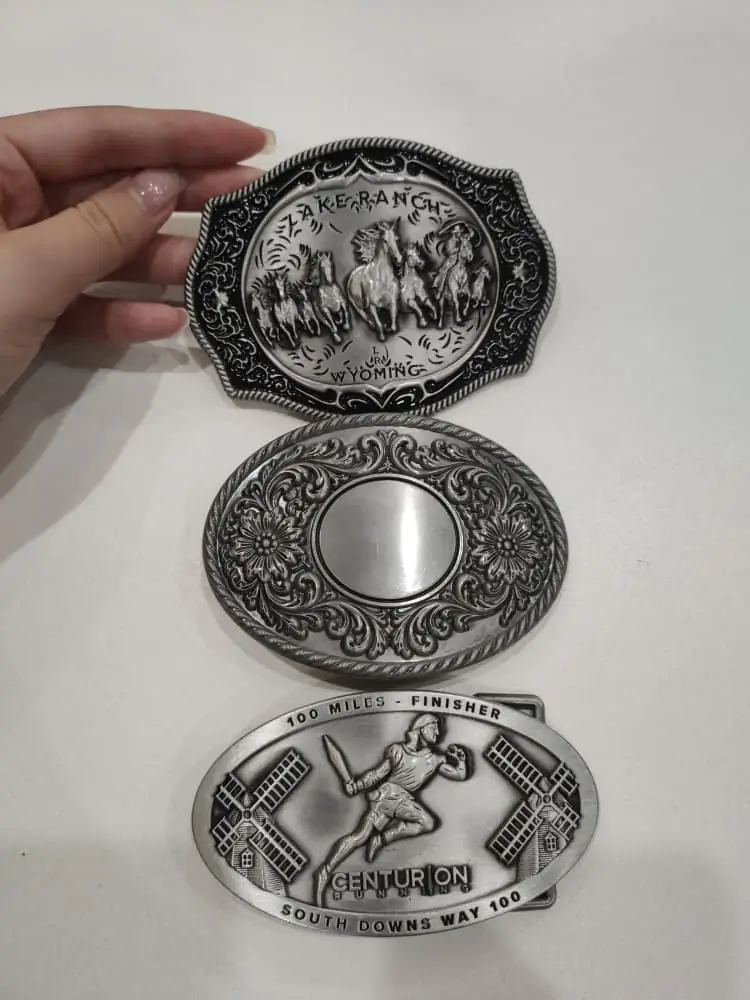
- Blank: lowest cost, cleanest look, no traceability.
- Raised text: cast into the mold. Free per-piece once tooled, but identical on every unit — ideal for brand name, year or edition text.
- Laser-marked text: fine, permanent, and variable per piece. The right choice for serial numbers or individual recipient names.
- Engraved text: deeper cut with a more premium tactile feel, commonly used on award and trophy buckles.
If you’re producing award buckles with individual names, decide early whether names are laser-marked at the factory or locally after delivery. Factory marking is cheaper and cleaner; local marking protects you when winners aren’t known until the event itself.
Attachment and strap fit
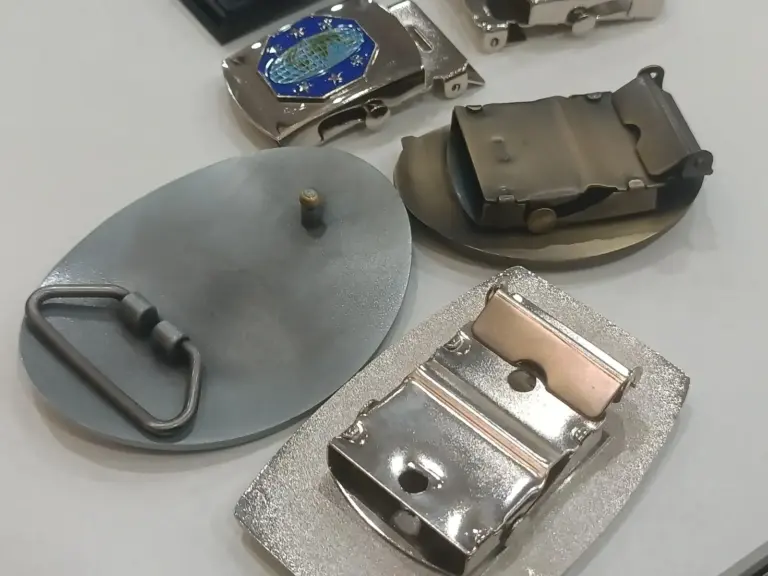
Belt buckles use a loop-and-bar attachment welded or cast to the back, and there are several standard configurations. The one that matters is the one that fits your strap. Confirm three numbers before approving the mold:
- Strap width. 38 mm (1.5″) is the most common snap-belt standard, but 32 mm and 44 mm straps exist. A 38 mm buckle on a 40 mm strap is scrap.
- Strap thickness. Thick full-grain leather needs more clearance under the loop than thin bonded leather.
- Bar position. Determines how the buckle sits and whether the tongue engages the holes correctly.
If you’re buying buckles and straps from different suppliers, send the factory a physical strap sample or its exact dimensions. This one step prevents the most expensive category of belt buckle failure — a full container of buckles that don’t fit the belts you already bought.
Step 5: Understand How the Price Is Actually Built
A belt buckle quote is made of four separate components. Suppliers who bundle them into one number are harder to compare, so ask for the breakdown explicitly.
1. Mold / tooling fee
A one-time charge per design, covering the steel mold your buckle is cast or struck from. It is unrelated to quantity — the same fee applies whether you order 50 or 5,000. Two questions worth asking: is the mold retained for reorders (it should be, at no extra cost), and is the fee reduced or credited at higher order volumes? Custom outlines and complex 3D sculpts cost more to tool than standard shapes.
2. Unit price
Driven by size, weight, process, number of enamel colours, plating type and any add-ons such as rhinestones or glitter. Size and weight matter more than most buyers expect — an oversized trophy buckle can use twice the metal of a standard one.
3. Add-ons
Packaging, individual poly-bagging, backer cards, barcode labels, laser personalisation and specialty plating are all quoted separately. List them in the RFQ so they appear in the first quote instead of the final invoice.
4. Freight, duty and clearance
Metal buckles are dense, so freight is a real line item rather than a rounding error. Air express suits samples and urgent top-ups; air freight suits mid-size orders against a deadline; sea freight is dramatically cheaper per unit but needs six to eight weeks of runway. Confirm the Incoterm — EXW, FOB, DDP — because a low FOB price and a high DDP price can be the same total landed cost.
On MOQ: Flyances runs from 50 pieces on custom buckle programmes, which makes test runs and small club orders viable. Just be aware that per-unit economics improve sharply between 50 and 500 pieces — if you know an annual reorder is coming, consolidating into one production run usually beats two small ones.
Step 6: Artwork Proof, Sampling and Pre-Production Approval
The production sequence at Flyances runs in three stages: you send your design or idea, the factory returns free artwork, and production follows from the approved file. Each handover is a checkpoint — use them.
Digital artwork proof
You receive a rendered proof showing dimensions, colours with Pantone references, plating, backside layout and attachment. Review it as a specification document, not a picture. Check spelling character by character, verify the year, and confirm every Pantone code against your brand guidelines. Approving artwork with a typo means approving a mold with a typo.
Pre-production sample
For a first order, always take a physical sample. Renders cannot communicate weight, plating tone under real light, or how a strap seats in the loop. When it arrives, check against this list:
- Dimensions match the approved spec, measured not eyeballed
- Plating tone and coverage — including edges, recesses and the reverse
- Enamel colours against physical Pantone chips, in daylight
- Backside text: spelling, alignment, legibility
- Attachment fits your actual strap, and the tongue engages cleanly
- Weight and hand-feel appropriate to your retail price point
- No casting flash, pitting, sharp edges or polishing marks
Keep the approved sample. It becomes the reference standard for this order and for every reorder afterwards, and it is your evidence if a later batch drifts.
Sampling costs time — typically around a week for mold cutting plus sample production, before shipping. Build it into your schedule rather than treating it as optional. If you’re working to a hard event date, say so upfront so the factory can sequence accordingly.
Step 7: Production Timeline and Freight Planning
Typical durations for a standard custom belt buckle order. Confirm actual dates against your specific quantity and season — these are planning figures, not guarantees.
Stage | Typical duration | Notes |
Quotation | 24–48 hours | Faster with a complete spec sheet |
Artwork proof | 1–3 working days | Free; allow a round or two of revisions |
Mold making + sample | 7–10 days | Complex 3D sculpts sit at the longer end |
Sample shipping | 3–5 days | Express courier |
Your approval | Your control | The most common source of schedule slip |
Mass production | 10–20 days | Scales with quantity, plating type and finishing steps |
QC + packing | 2–3 days | Inspection, packing, carton marking |
Sea freight | 25–40 days | Port to port, excluding customs clearance |
Air freight | 5–10 days | Excluding clearance |
Air express | 3–6 days | Door to door, best for samples and urgent top-ups |
Two seasonal factors to plan around. Chinese New Year shuts Chinese manufacturing for roughly two to four weeks between late January and February, with capacity tightening for weeks beforehand as everyone rushes to ship. And Q3 to Q4 is peak season across promotional products, so lead times stretch. If you need buckles for a spring event, place the order before the New Year break, not after it.
Step 8: Quality Control and Compliance
Quality problems on belt buckles are rarely dramatic. They are small and cumulative: plating tone drifting between batches, enamel bleeding at a colour boundary, an attachment welded fractionally off-centre. Individually minor, collectively enough to lose an account.
Specify what you want inspected instead of assuming it is covered:
- Inspection standard. State an AQL level (AQL 2.5 for general merchandise is a common baseline) and define what counts as a major versus minor defect.
- Batch consistency. Plating tone should be checked against the retained approved sample, not against another piece from the same batch.
- Functional check. Attachment strength and strap fit on a sampled percentage of units.
- Photo report. Pre-shipment images of packed goods, carton markings and randomly pulled units.
- Third-party inspection. Available on request, and worth it on first orders or high-value programmes.
Flyances operates quality control positions inside its own factories and submits product for third-party inspection — the quality control process is documented, and the certification portfolio covers ISO 9001, TUV, Intertek, SEDEX, REACH, RoHS, ASTM and CE. For buyers whose customers audit their supply chain, SEDEX in particular carries weight, since it covers labour conditions rather than product testing alone.
If you want to see how this plays out on real programmes, the client case studies cover work delivered for brands including EY, Hot Wheels, 24 Le Mans, Carlsberg and McDonald’s.
Step 9: Packaging and Retail Readiness
Packaging is not decoration — it determines whether goods can go straight to a shelf, straight to a recipient, or need re-handling in your warehouse. Available options include:
- OPP bag: lowest cost, basic protection, suitable for bulk distribution
- Bubble bag: protects plated surfaces from scuffing in transit — sensible for antique and matt finishes
- Backer card: retail-ready hanging presentation, carries branding and barcode
- Paper box / hard paper box: clean gifting presentation at moderate cost
- Velvet box: premium award presentation — the standard for trophy buckles
- Wooden box: highest perceived value, used for commemorative and executive programmes
- Acrylic box: modern display presentation where the product stays visible
If your goods are heading into retail or a 3PL, confirm barcode placement, inner and outer carton quantities, and carton labelling requirements in the same email as the packaging choice. Getting this wrong means repacking an entire shipment on arrival at your cost.
How to Vet a Custom Belt Buckle Supplier
Most sourcing disappointment traces back to supplier selection rather than to anything that happened during production. Five questions separate a factory from a reseller quoting on top of one.
- Do you own the tooling and production floor? A trading company adds margin and a communication layer between you and the people making decisions. Ask for factory photos, an address, and a video walkthrough — a real factory has no reason to decline.
- What is the mold retention policy? Get in writing that your mold is kept and reusable on reorders at no additional tooling charge.
- What happens if a batch is rejected? Rework, replacement, credit — and who pays freight. Settle it before the first order, not during a dispute.
- Which certifications do you actually hold? Ask for the certificates themselves and check the issuing body and expiry date.
- Can you show comparable work? Not a generic catalogue — buckles at your complexity level, in your finish, for buyers like you.
Flyances has manufactured promotional metal products for over 20 years from Zhongshan, Guangdong, with in-house factories and free design support. You can review the manufacturing capability, browse the product catalogue PDFs, or send artwork directly through the contact page.
Six Mistakes That Cost B2B Buyers Money
- Comparing quotes that aren’t comparable. Without a fixed spec, the cheapest quote is usually the thinnest casting with the cheapest plating.
- Approving artwork too quickly. A typo caught at proof stage costs nothing. Caught after tooling, it costs a new mold and two weeks.
- Skipping the physical sample. Weight, plating tone and strap fit cannot be judged from a render.
- Ignoring strap compatibility. The single most expensive avoidable error in this category.
- Planning backwards from the ship date. Plan from your in-hands date, then subtract clearance, freight, QC and production.
- Treating packaging as an afterthought. Retail requirements added after production mean repacking, and repacking costs more than doing it right.
Frequently Asked Questions
What is the minimum order quantity for custom belt buckles?
Flyances produces custom buckles from 50 pieces, which suits test runs, club orders and small event programmes. Per-unit pricing improves significantly as quantity rises, with the steepest improvement between 50 and 500 pieces.
How much does the mold fee cost, and is it charged again on reorders?
The mold fee is a one-time charge per design that covers steel tooling, and it varies with shape complexity and whether the design is 3D sculpted. Once tooled, the mold is retained, so reorders of the same design do not incur it again. Confirm this in writing with any supplier.
How long does a full custom belt buckle order take?
Allow roughly one to two weeks for artwork and sampling, then two to three weeks for mass production and QC, plus shipping — three to six days by air express, or four to six weeks by sea. Total lead time is commonly six to ten weeks door to door, depending on freight mode and season.
What is the difference between die-struck and soft enamel belt buckles?
Die-struck buckles carry the design as raised metal relief with no colour fill, giving a premium and highly durable result. Soft enamel adds recessed colour between raised metal lines, which is brighter and more cost-effective. Die-struck suits heritage and award pieces; soft enamel suits logo and event merchandise.
Can you match my brand’s exact colours?
Yes — supply Pantone solid coated codes rather than colour names or screenshots. Enamel colour is matched to the code and confirmed on the pre-production sample, which is then retained as the reference for future reorders.
Do custom western belt buckles need a different specification?
Usually, yes. Western buckles rely on 3D sculpted relief and antique finishing to read correctly — rope borders, scrollwork and multi-level depth. They are also typically larger and heavier than corporate logo buckles, which affects both material cost and freight.
Which belt strap width do your buckles fit?
Buckles can be tooled to fit any standard strap width, with 38 mm (1.5″) the most common. Always confirm your strap width, thickness and material before mold approval — especially if buckles and straps come from different suppliers.
Can you handle personalised names on award buckles?
Yes. Individual names, dates and event details can be laser-marked or engraved per piece. If recipients are unknown until the event, discuss whether to mark at the factory or leave a blank engraving panel for local finishing.
Ready to Start Your Custom Belt Buckle Programme?
Send your design, sketch or reference image and Flyances will return free artwork and a full quotation — no commitment required. Start with the custom belt buckle range, download the product catalogues, or contact the team directly with your spec sheet.
Building a wider merchandise or awards programme? The same factory also produces custom medals, enamel pins, embroidered patches and custom caps — consolidating them into one order shares tooling coordination, one QC cycle and one shipment.
More Posts
Custom Belt Buckle Materials: Zinc Alloy vs Brass vs Stainless Steel
Table of Contents Material is the first decision in a belt buckle project and the one that quietly determines everything
How Much Do Custom Belt Buckles Cost? A Factory Pricing Guide
Table of Contents Ask five suppliers what a custom belt buckle costs and you can get answers from under $2