
How Much Do Custom Belt Buckles Cost? A Factory Pricing Guide
Table of Contents
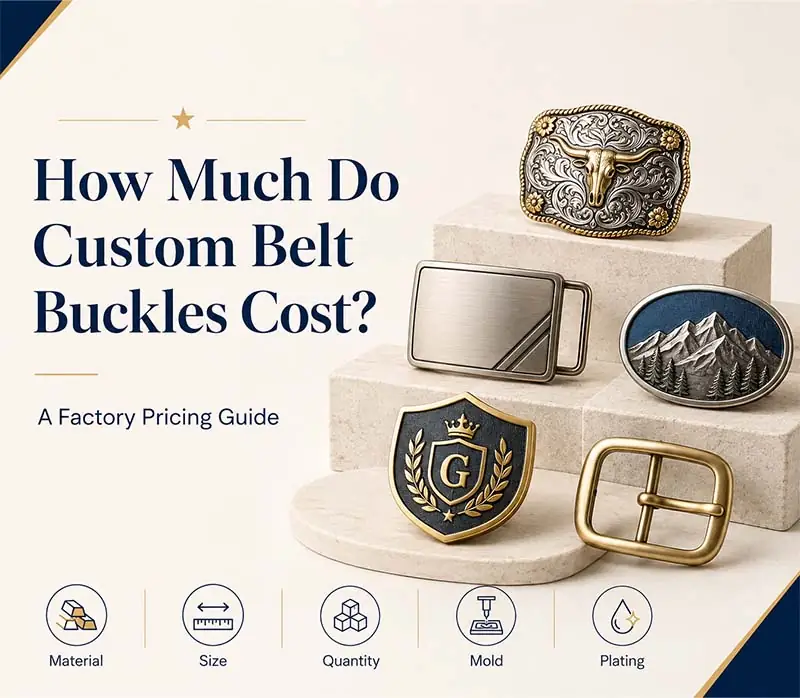
Ask five suppliers what a custom belt buckle costs and you can get answers from under $2 to over $100 for what sounds like the same product. Neither number is wrong. They are answers to different questions.
The spread comes from three things: where the buckle is made, how it is made, and how many you order. Understanding those three variables turns an impossible comparison into a straightforward one. This guide breaks down every line item in a custom belt buckle quote — tooling, unit price, finishing, packaging and freight — so you can budget accurately, compare quotes fairly, and recognise when a low price is a genuine saving rather than a warning sign.
All figures in this guide are indicative market ranges for planning purposes. Actual pricing depends on your specific design, quantity, finish and destination — request a quote against your own spec.
The Short Answer: Typical Price Ranges
Custom belt buckle pricing splits cleanly by sourcing channel. This is the single biggest cost variable — larger than size, process or quantity.
Sourcing channel | Typical unit price | Typical MOQ | What you are paying for |
Factory-direct (China) | US$1.50–6.00 | 50–500 pcs | Direct manufacturing cost with no reseller margin; you manage freight and import |
Overseas via a domestic reseller | US$4–12 | 25–100 pcs | Factory production plus a distributor margin, local invoicing and support |
Domestic manufacture (US) | US$15–30 | 25–100 pcs | Local production, short freight, no import exposure, higher labour cost |
Handmade / artisan (silver, one-off) | US$99–300+ | 1 pc | Individual craftsmanship and premium materials, not a production process |
For B2B volume buyers, the realistic decision sits between the first three rows. Published market listings for custom die-cast zinc alloy belt buckles from Chinese manufacturers commonly sit in the US$1.50–3.00 band for standard sizes at volume, rising with size, brass content, 3D sculpting and stone or glitter work. US-made equivalents commonly run US$15–30 per piece even on larger runs, with single artisan pieces exceeding US$100.
For reference, Flyances lists custom buckle programmes from a 50-piece minimum, with catalogue pricing on standard zinc alloy designs starting around US$1.98 per piece before tooling and freight. That is factory pricing from company-owned production in Zhongshan, Guangdong — not a trading margin on top of someone else’s output.
The Five Components of a Belt Buckle Quote
Every quote you receive is made of the same five parts, whether the supplier itemises them or not. Ask for the breakdown — a supplier who will not separate these is either a reseller who cannot, or hoping you will not notice where the margin sits.
- Mold / tooling. One-time, per design, independent of quantity.
- Unit price. Per-piece manufacturing cost, driven by size, weight, process and finish.
- Finishing and add-ons. Specialty plating, personalisation, stones, colour count.
- From a poly bag to a wooden presentation box — a wider range than most buyers expect.
- Freight, duty and clearance. Material on dense metal goods; the difference between FOB price and landed cost.
Component 1: Mold and Tooling Cost
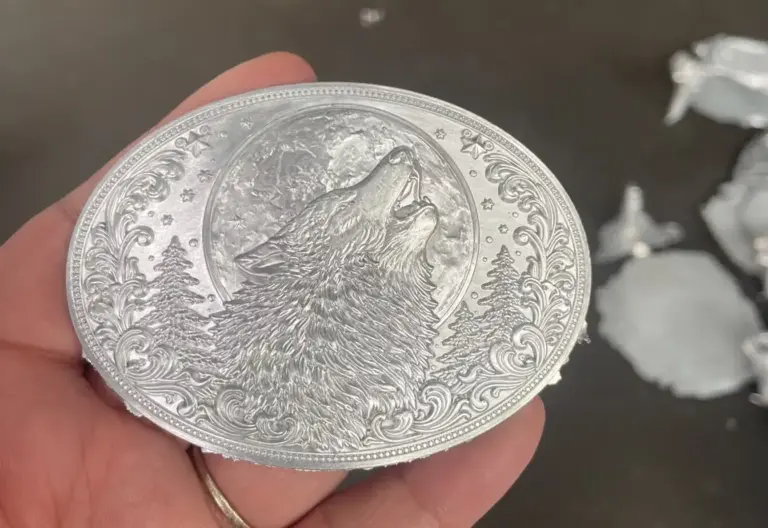
The mold is the steel tool your buckle is cast or struck from. It is cut once per design, charged once, and then reused indefinitely. Because it is a fixed cost spread over your order quantity, it dominates the economics of small runs and disappears into rounding on large ones.
What drives the tooling price
- A larger buckle needs a larger tool cavity.
- Standard oval or rectangle is cheapest; a fully custom outline costs more.
- Relief depth. Flat two-dimensional artwork is cheapest. Multi-level 3D sculpting requires hand or CNC sculpting work before the tool is cut, and is the largest single tooling variable.
- Die-struck dies and die-cast molds are priced differently.
- Two-sided detail. Raised text or artwork on the reverse adds tooling work.
As a market reference point, US-based casting suppliers commonly publish one-time mold charges in the region of US$300 or more per design, with additional charges for custom sculpting. Chinese factory tooling for a comparable design is typically a fraction of that, which is why the tooling line is often where the sourcing decision is really made.
The part most buyers get wrong: amortisation
Tooling is not a per-unit cost, but it behaves like one until your volume rises. The table below shows how a single mold charge lands on your effective unit cost — using an illustrative US$150 tooling fee.
Order quantity | Unit price (example) | Mold cost per unit | Effective cost per unit |
50 pcs | $2.60 | $3.00 | $5.60 |
100 pcs | $2.40 | $1.50 | $3.90 |
300 pcs | $2.10 | $0.50 | $2.60 |
500 pcs | $1.95 | $0.30 | $2.25 |
1,000 pcs | $1.80 | $0.15 | $1.95 |
3,000 pcs | $1.65 | $0.05 | $1.70 |
Illustrative figures for structure only — not a quotation.
Two practical conclusions. First, at 50 pieces you are effectively buying tooling with some buckles attached, so judge small runs on total project cost rather than unit price. Second, if you know an annual reorder is coming, one run of 500 usually beats two runs of 250 — not because of the tooling, which is already paid, but because of the production-run efficiencies.
Always confirm the mold retention policy in writing. Industry practice is that the factory retains your mold and reorders of the same design carry no further tooling charge; some suppliers retain molds for a defined period such as two years. Get the term stated, because a supplier who quietly re-charges tooling on a reorder has effectively raised your price by 100% on a small run.
Component 2: Unit Price and What Moves It
Once tooling is set aside, the per-piece price is driven by a predictable set of factors. Here is the direction and rough weight of each.
Factor | Impact | Explanation |
Size and weight | High | Metal is priced by weight. An oversized trophy buckle can use twice the alloy of a standard 75 mm design, and freight scales with it too. |
Base metal | High | Zinc alloy is the cost-efficient default. Brass costs meaningfully more per gram; stainless steel adds machining cost. |
Process | High | Printed and soft enamel sit at the low end. Die-struck and multi-level 3D casting sit higher because of tooling complexity and finishing labour. |
Plating | Medium | Standard gold, silver and nickel are baseline. Antique, matt and black nickel finishes involve extra steps and typically carry a modest upcharge. |
Enamel colour count | Medium | Each additional colour is a separate fill and cure operation. Consolidating from six colours to four is a real saving. |
Stones, glitter, epoxy | Medium–high | Rhinestone setting is hand work and scales directly with stone count. |
Backside treatment | Low–medium | Raised text cast into the mold is free per piece. Laser marking or engraving per unit — especially variable names — adds per-piece labour. |
Quantity | High | Setup, plating bath and QC costs spread across the run. |
Lead time | Variable | Rush production carries a premium; a relaxed schedule can be scheduled into spare capacity. |
Indicative unit price bands
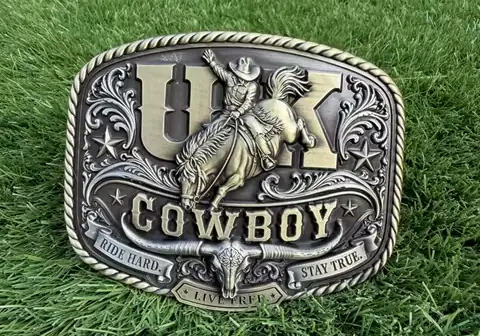
Factory-direct FOB pricing, zinc alloy unless noted, at moderate volume (300–500 pcs), standard 75–95 mm size:
Specification | Indicative FOB | Notes |
Soft enamel, standard shape, standard plating | $1.30–2.20 | The value tier — logo buckles, event merchandise, souvenir retail |
Die-struck or 3D relief, antique finish | $1.90–3.50 | The mainstream western and award specification |
Oversized 3D trophy buckle, premium plating | $3.00–6.00 | Larger, heavier, more finishing labour |
Brass die-struck | $3.50–8.00 | Higher raw material cost, premium hand feel |
Rhinestone or glitter work | $0.30–1.50 | Add-on to any of the above; scales with stone count |
Planning ranges based on published market pricing, not a quotation. Send your artwork and quantity for an accurate figure.
Component 3: Finishing and Add-Ons
These are the line items most likely to appear after you thought the price was settled. List them in your RFQ so they land in the first quote.
- Specialty plating. Antique brass, antique copper, matt nickel, black nickel and dye black each involve extra process steps beyond bright plating.
- Individual personalisation. Laser-marking a different name on each piece is per-unit labour, unlike raised text cast into the mold. On award programmes this is often worth it; budget for it explicitly.
- Serial numbering. Sequential numbering is usually a modest one-time setup. Out-of-sequence or specific numbers cost significantly more per piece.
- Epoxy doming. Adds scratch protection and depth to printed designs at low cost.
- Two-sided decoration. Artwork on the reverse means additional tooling and finishing.
- Physical sample. Often charged, and often credited against the production order. Ask which.
- Compliance testing. Third-party lab testing for a specific market is quoted per report, not per piece.
Flyances includes design artwork free of charge before any commitment, and holds REACH, RoHS, ASTM, CE, ISO 9001, TUV, Intertek and SEDEX certifications — which means for most markets the compliance documentation already exists rather than being an added project cost.
Component 4: Packaging
Packaging spans a wider cost range than buyers expect — on a premium programme it can rival the buckle itself. Choose against the end use, not by default.
Option | Relative cost | Right for |
OPP bag | Lowest | Bulk distribution where the buckle is fitted to a strap later |
Bubble bag | Low | Protecting antique and matt plating from transit scuffing |
Backer card | Low–medium | Retail hanging display; carries branding and barcode |
Paper / hard paper box | Medium | Corporate gifting and mail-out programmes |
Acrylic box | Medium–high | Display presentation where the product stays visible |
Velvet box | High | Trophy and award buckles — the presentation standard |
Wooden box | Highest | Commemorative, executive and collector programmes |
One cost trap worth naming: adding retail requirements after production. Barcodes, individual poly-bagging and carton labelling specified upfront cost very little. Specified after the goods are packed, they mean unpacking and repacking an entire shipment — sometimes at destination, at local labour rates.
Component 5: Freight, Duty and Incoterms
Metal buckles are dense. A carton of 500 zinc alloy buckles is heavy, so freight is a genuine line item rather than a rounding error, and the mode you choose changes your landed cost materially.
- Air express (3–6 days). Door to door. Right for samples and urgent top-ups; the most expensive per kilogram.
- Air freight (5–10 days). Airport to airport, plus clearance. Reasonable for mid-size orders against a deadline.
- Sea freight (25–40 days port to port). Dramatically cheaper per unit, but needs six to eight weeks of runway including clearance and inland delivery.
Confirm the Incoterm before comparing prices. EXW means you arrange everything from the factory gate. FOB means the supplier handles export clearance and loading at the port. DDP means the price includes freight, duty and delivery to your door. A low FOB quote and a high DDP quote can represent an identical landed cost — comparing them directly is meaningless.
Landed cost: a worked example
500 pieces, zinc alloy, 3D relief, antique brass finish, backer card packaging, shipped by sea:
Line item | Amount | Per unit |
Unit price FOB (500 × $2.20) | $1,100 | $2.20 |
Mold / tooling (one-time) | $150 | $0.30 |
Backer card packaging (500 × $0.12) | $60 | $0.12 |
Sea freight + clearance + inland | $125 | $0.25 |
Import duty (illustrative 4%) | $44 | $0.09 |
Total landed cost | $1,479 | $2.96 |
Illustrative only. Duty rates depend on HTS classification and destination country — confirm with your customs broker. Reorders of the same design drop the tooling line, taking this example to roughly $2.66 per unit.
Where the Volume Price Breaks Actually Happen
Quantity discounts are not linear. The curve is steepest at the bottom and flattens quickly. Indexing to a 50-piece order at 100:
Quantity | Relative unit price | What changes |
50 pcs | 100 | Minimum viable run; setup dominates |
100 pcs | ~88 | Setup starts spreading meaningfully |
300 pcs | ~78 | Full plating batch efficiency reached |
500 pcs | ~72 | The point most B2B programmes should target |
1,000 pcs | ~66 | Continuous production run |
3,000 pcs | ~60 | Diminishing further gains; inventory risk rises |
The practical takeaway: the move from 50 to 500 pieces captures most of the available saving. Beyond about 1,000, incremental discount slows while your cash and inventory exposure keeps climbing. For most distributors and brands, 300–500 pieces is the efficient point — not the largest order you can afford.
What to Budget by Buyer Type
Programme | Budget guidance | Where the money goes |
Promotional giveaway buckles | Lowest tier | Soft enamel, standard shape and plating, OPP bag. Optimise for unit cost. |
Corporate logo buckles | Mid tier | Pantone accuracy and finish consistency across annual reorders matter more than the last 10 cents. |
Western retail buckles | Mid–upper tier | 3D relief and antique finishing drive perceived value and support the retail price. Do not economise on the sculpt. |
Rodeo and trophy buckles | Upper tier | Larger size, heavier metal, engraving and velvet box presentation. The buckle is the award. |
Souvenir and tourist retail | Low–mid tier | Bright colour, backer card, low unit cost. Volume carries the margin. |
Award programmes often make more sense costed as a set rather than a line item — buckles for winners, custom medals for placings, and enamel pins for participants. Consolidating into one production run shares tooling coordination, one QC cycle and one shipment, which usually beats sourcing each separately.
Factory-Direct vs Domestic Supplier vs Reseller
Price is not the only axis. Here is the honest trade-off.
Factory-direct overseas | Domestic reseller | Domestic manufacturer | |
Unit price | Lowest | Medium | Highest |
MOQ | 50–500 pcs | 25–100 pcs | 25–100 pcs |
Lead time | 6–10 weeks by sea | 4–8 weeks | 3–6 weeks |
Import handling | You or a DDP arrangement | Handled for you | None |
Communication | Direct with production | Via account manager | Direct and local |
Best for | Volume, repeat programmes, margin-sensitive resale | One-off orders, buyers new to importing | Very short deadlines, “Made in USA” requirements |
Factory-direct wins on unit cost and on control of specification, and the gap widens with volume. It costs you lead time and requires you to manage import — or work with a supplier who quotes DDP. If you are running repeat programmes at 300 pieces or more, that trade generally favours going direct; below 100 pieces on a tight deadline, it may not. Flyances works with brands, wholesalers and distributors worldwide on OEM and ODM terms, and the client case studies cover programmes for EY, Hot Wheels, 24 Le Mans, Carlsberg and McDonald’s.
Seven Ways to Cut Cost Without Cheapening the Product
- Reduce size before you reduce quality. Dropping from 95 mm to 80 mm cuts metal, plating area and freight weight simultaneously — and rarely hurts perceived value the way thin casting does.
- Consolidate enamel colours. Going from six colours to four removes fill and cure operations. Most logos survive the edit.
- Use raised text instead of per-piece marking. If the reverse copy is the same on every unit, cast it into the mold and pay nothing per piece.
- Order one run, not two. If you know a reorder is coming within the year, combine them.
- Ship by sea and plan for it. The saving over air is substantial; the cost is calendar discipline.
- Match packaging to the actual end use. A velvet box on a giveaway buckle is money spent where nobody is looking.
- Avoid the Chinese New Year rush. Ordering into the pre-holiday crunch means rush fees and stretched lead times. Place orders before the queue forms.
When a Low Quote Should Worry You
Cheap is not the same as suspicious — factory-direct pricing is genuinely lower for structural reasons. But some low quotes are low because something has been quietly removed. Check for these:
- Thin casting. Weight is the easiest thing to shave and the hardest to see in a photo. Specify a target weight or approve a physical sample.
- Minimal plating thickness. Thin plating wears through at the edges months after delivery, which is exactly when it becomes your problem.
- Tooling excluded from the quote. A quote without a mold line is not a complete quote.
- A different process than you asked for. Printed artwork quoted against a die-struck request will always look cheaper.
- No inspection standard. If nobody agreed an AQL level, nobody is committed to a defect rate.
- EXW pricing presented as the total. Everything after the factory gate is still to come.
The reliable defence is a documented quality control process and an approved physical sample retained at the factory as the batch reference — not a lower or higher price.
Comparing Three Quotes: A Worked Example
You asked three suppliers for 500 custom logo buckles. The quotes come back at $1.80, $2.40 and $9.50. Normalising them:
| Supplier A — $1.80 | Supplier B — $2.40 | Supplier C — $9.50 |
Process quoted | Printed insert | 3D die-cast, soft enamel | 3D die-cast, soft enamel |
Tooling | Not listed | $150, retained for reorders | Included |
Packaging | Not listed | Backer card included | Poly bag |
Incoterm | EXW | FOB | Delivered |
Freight + duty | Your cost, unquantified | ~$0.34/unit | Included |
Estimated landed | Unknown — incomplete | ~$3.06 | ~$9.50 |
Verdict | Not comparable; different product | Best value on spec | Convenience premium |
Supplier A is not cheaper — it is quoting a different product with several costs still to arrive. Supplier C may still be the right answer if you need it in three weeks with no import work. Supplier B is the like-for-like winner. None of this is visible until you itemise, which is why the itemised breakdown is the request that matters most.
Frequently Asked Questions
How much does a custom belt buckle cost per piece?
Factory-direct from China, expect roughly US$1.50–6.00 per piece for zinc alloy at moderate volume, depending on size, process and finish. Domestic US manufacture commonly runs US$15–30 per piece, and handmade artisan pieces start around US$99. Tooling and freight sit on top of the unit price in all cases.
How much is the mold fee for custom belt buckles?
Tooling is charged once per design and priced on size, shape complexity and relief depth, with 3D sculpting the largest variable. US casting suppliers commonly publish mold charges around US$300 or more per design; overseas factory tooling is typically a fraction of that. Confirm the exact figure with your spec, and confirm that reorders of the same design carry no further charge.
Is the mold fee charged again on reorders?
It should not be. Standard practice is that the factory retains your mold and reorders of the same design pay unit price only. Some suppliers define a retention period such as two years. Get the policy in writing before the first order.
What is the cheapest way to make custom logo buckles?
Soft enamel or printed artwork on a standard-shape zinc alloy blank, with standard plating, cast raised text on the reverse, and OPP bag packaging, ordered at 500 pieces or more and shipped by sea. That combination removes cost from the places buyers notice least.
Do custom belt buckles get cheaper in bulk, and by how much?
Yes, but not linearly. Most of the available saving is captured between 50 and 500 pieces — roughly a quarter to a third off the unit price. Beyond 1,000 pieces the discount curve flattens while inventory risk rises, so the largest order is rarely the most efficient one.
What is the minimum order quantity, and does a low MOQ cost more per piece?
Flyances produces custom buckles from 50 pieces. Yes, low quantities carry a higher unit price because setup, plating batch and QC costs spread across fewer units — and the one-time tooling charge lands harder. Judge small runs on total project cost rather than unit price.
Why are custom western belt buckles more expensive than logo buckles?
Western designs rely on multi-level 3D sculpted relief and antique finishing, both of which add tooling and hand-finishing work. They are also typically larger and heavier, which raises both metal cost and freight weight.
Does the quoted price include shipping and import duty?
Only if the Incoterm says so. EXW excludes everything past the factory gate, FOB includes export clearance and loading, DDP includes freight, duty and delivery. Always confirm the Incoterm before comparing quotes — it can account for the entire apparent price difference.
Get an Itemised Quote for Your Design
The only way to know what your buckle costs is to price your actual specification. Send a design, sketch or reference image with your target quantity and Flyances will return free artwork plus an itemised quote — tooling, unit price, packaging and freight separated, so you can compare it honestly against anything else on your desk.
Start with the custom belt buckle range, download the product catalogues, or send your spec to the team. For the full ordering process from spec sheet to shipment, see How to Order Custom Belt Buckles: A Complete B2B Buyer’s Guide
More Posts
Custom Belt Buckle Materials: Zinc Alloy vs Brass vs Stainless Steel
Table of Contents Material is the first decision in a belt buckle project and the one that quietly determines everything
How to Order Custom Belt Buckles: A Complete B2B Buyer’s Guide
Table of Contents Sourcing custom belt buckles looks straightforward until the quotes come back. Three suppliers, three prices that differ