
Custom Belt Buckle Materials: Zinc Alloy vs Brass vs Stainless Steel
Table of Contents
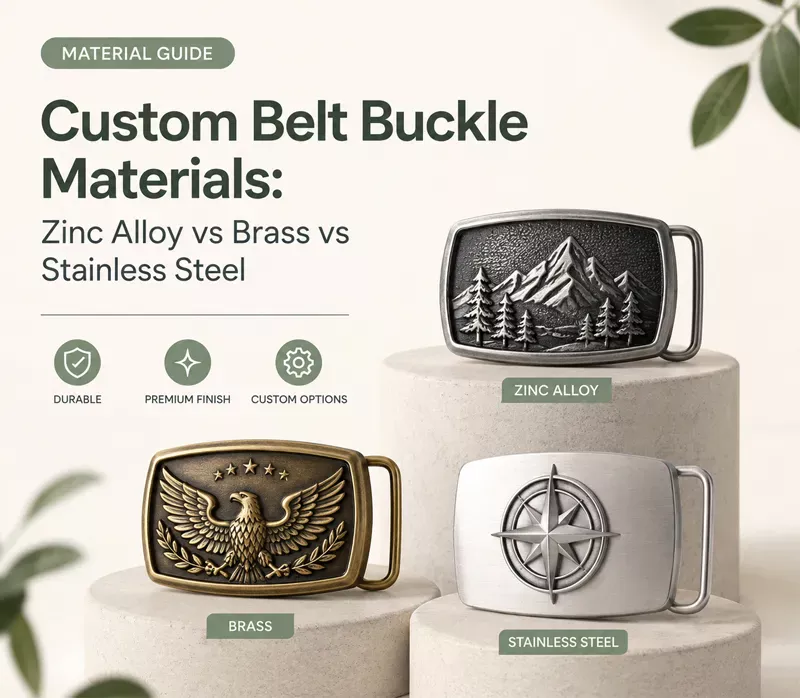
Material is the first decision in a belt buckle project and the one that quietly determines everything after it. It sets what the design can look like, what it weighs in the hand, which plating finishes are available, what it costs per piece, and whether it clears the regulations in your destination market.
It is also the decision most buyers make by default. “Zinc alloy” appears on the quote, nobody questions it, and it is usually right — but “usually right” is not the same as “right for this programme.” A rodeo trophy buckle, a corporate service award and a souvenir shop item have genuinely different material answers.
This guide compares the three metals used in serious custom belt buckles production — zinc alloy, brass and stainless steel — on the criteria that actually affect a B2B buying decision: detail reproduction, weight, durability, finish compatibility, cost and compliance. It is written for distributors, brand owners and procurement teams who need to specify correctly the first time.
Quick Comparison: The Three Materials for Belt Buckles at a Glance
Criterion | Zinc alloy | Brass | Stainless steel |
|---|---|---|---|
Forming method | Die casting (molten metal into a mold) | Die striking (sheet stamped under pressure) | Stamping, cutting, CNC machining |
3D detail capability | Excellent — handles deep multi-level relief | Very good — crisp, shallower relief | Limited — shallow relief only |
Approx. density | ~6.6 g/cm³ | ~8.5 g/cm³ | ~7.9 g/cm³ |
Hand feel | Solid and substantial | Noticeably heavier, dense | Firm, hard, cool to touch |
Plating range | Widest — accepts every finish | Wide; also wearable unplated | Narrower; often left as brushed or polished steel |
Corrosion resistance | Good when plated | Good; develops patina unplated | Excellent — the best of the three |
Relative cost | Lowest | Higher | Highest to machine |
Best for | Most custom programmes: western, logo, event, retail | Premium awards, heritage, die-struck detail | Tactical, industrial, marine, heavy daily wear |
If you read nothing else: zinc alloy is the correct default for the large majority of custom belt buckle programmes. Brass is the upgrade when weight and die-struck crispness justify the cost. Stainless steel is a functional choice for harsh-use applications, not an aesthetic upgrade.
Zinc Alloy: The Production Standard
Zinc alloy — the die-casting family commonly known as Zamak, a zinc base with aluminium and copper — accounts for the overwhelming majority of custom belt buckles made worldwide. That is not a compromise; it is the result of zinc doing several things better than the alternatives at once, and choosing the right material affects durability, weight, appearance, comfort on the belt, and resistance to moisture. As a common material for custom buckles, zinc alloy is also more affordable than solid metals, though less durable over the long term.
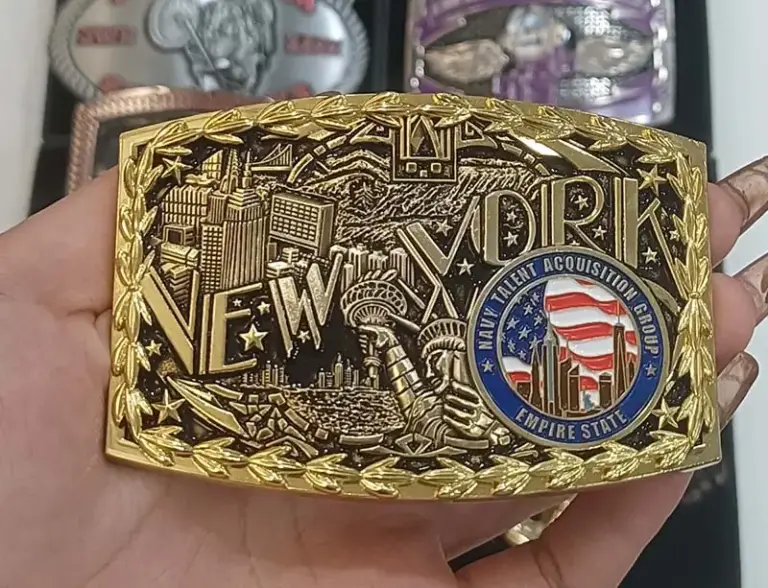
Why it dominates
Zinc alloy has a relatively low melting point and excellent flow characteristics in the mold, and is commonly blended with copper, aluminum, and magnesium. Molten metal is injected under pressure into a steel die, and its ability to fill the mold makes complex, intricate relief possible where other metals simply cannot reach. That is what makes deep, multi-level western relief possible — rope borders, sculpted longhorns, layered scrollwork with real shadow depth.
It also accepts every plating finish cleanly, which matters more than buyers realise. The same mold in zinc can be finished as bright gold, antique brass, matt nickel, black nickel or dye black — five completely different products from one tooling investment. Zinc alloy buckles are also commonly finished with nickel-free plating for skin-contact markets.
Strengths
Unmatched detail reproduction. The only sensible choice for sculpted 3D designs.
Full plating compatibility. Bright, matt, antique and dark finishes all work.
Complex shapes and cut-outs. Openwork and custom outlines are straightforward, and that versatility is part of why Zinc Alloy suits a wide range of custom programmes.
Best cost per piece. Lower material cost and faster cycle times than the alternatives.
Good weight-to-cost ratio. Substantial in the hand without brass-level material cost.
Enamel-friendly. Works well with soft enamel colour fill and epoxy doming.
Limitations
Softer than brass or steel. Fine raised edges can deform under genuine abuse — not an issue in normal wear, and perfectly suitable for everyday wear even if it is not the best option for extreme abuse compared with solid brass or stainless steel.
Depends on its plating. Zinc is not typically worn bare, so plating quality carries the durability. Thin plating wearing through at the edges is the most common zinc buckle failure, and it appears months after delivery.
Lighter than brass. At identical dimensions a zinc buckle weighs roughly three-quarters of a brass one — detectable in the hand on premium pieces.
Zinc alloy is the standard base for Flyances buckle production, available across the full plating library and every craft process. Because the buckle product range is built around it, the tooling, plating and finishing steps are already optimised — which is part of why it is the cost-efficient option rather than merely the cheap one.
Brass: The Premium Die-Struck Choice
Brass is a copper-zinc alloy, denser and warmer in tone than zinc alloy, and it is formed differently. It is corrosion resistant and malleable enough for intricate die-struck designs, making it an ideal choice when you want finer detail with a premium feel. Rather than being cast from molten metal, brass buckles are typically die-struck: a sheet of brass is stamped under enormous pressure between hardened dies. The metal is compressed rather than poured, which produces exceptionally crisp lines and a dense grain structure.
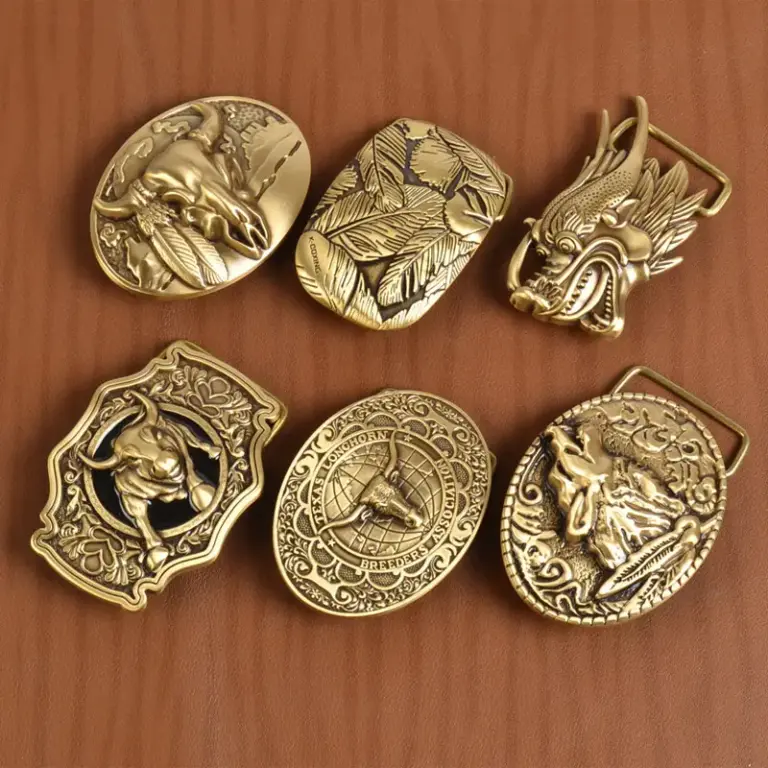
What brass gives you
Weight. Brass is roughly 28% denser than zinc alloy. A buyer who picks up both will feel the difference immediately, and weight reads as quality.
Crispness. Die-striking produces sharper edges and cleaner lettering than casting.
Warm natural tone. Brass can be worn unplated, developing a patina over years. Zinc cannot do this.
Longevity. Denser structure, better resistance to deformation, and no plating layer to wear through if left bare.
Heritage association. For military, service, commemorative and legacy programmes, solid brass carries meaning that plated zinc does not.
The trade-offs
Higher material cost. Copper content makes brass meaningfully more expensive per gram, and the price moves with commodity markets.
Shallower relief. Die-striking cannot achieve the deep multi-level sculpting that casting can. If your design depends on dramatic 3D depth, brass fights you.
Heavier freight. Denser metal means heavier cartons — a real line item on volume orders.
Unplated brass tarnishes. Some buyers want the patina; others will read it as a defect. Set the expectation with your end customer, or specify a protective lacquer.
Brass belt buckles make most sense when the buckle is the award rather than an accessory — service recognition, milestone anniversaries, uniformed-service programmes, and heritage retail lines where the customer will hold the product before buying. The same logic that governs custom medals applies: on recognition pieces, perceived weight does a lot of the work.
Stainless Steel: Built for Hard Wear
Stainless steel is the functional specialist. It is chosen for what it survives rather than for how it looks, and it suits a narrower set of programmes than either zinc or brass; for buyers with sensitive skin, nickel-free buckles can matter as much as strength because they help prevent skin irritation from allergies. Titanium is another hard-wearing premium option, and 100% solid titanium buckles are hypoallergenic.
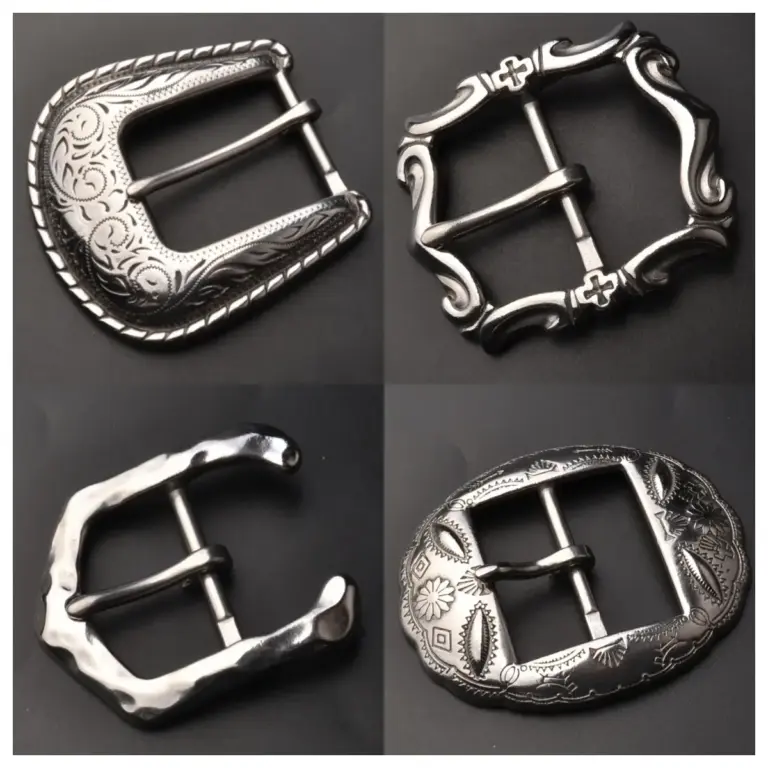
Where it wins
Corrosion resistance. The best of the three by a clear margin. Marine, coastal, humid and sweat-heavy environments do not degrade it, and appropriate grades are highly resistant in daily wear.
Hardness. Resists scratching, denting and edge deformation far better than zinc or brass.
No plating to fail. Typically finished as brushed or polished steel, so there is no coating layer that can wear through.
Low nickel-release options. Appropriate grades can be specified for skin-contact sensitivity, and nickel-free specifications are increasingly popular as allergy awareness grows — relevant for uniform programmes.
Where it loses
Detail is limited. Steel does not cast like zinc and does not strike as easily as brass. Deep sculpted relief is effectively off the table; designs need to be flat, engraved or shallow-etched.
Higher processing cost. Steel is harder to cut, form and machine, so labour and tool wear push the cost up even though the raw material is not expensive.
Restricted finish range. You are largely choosing between brushed, polished and PVD-coated. The antique and enamel-heavy looks that define western buckles are not natural fits.
The honest summary: choose stainless steel when the buckle must survive something. Tactical and duty belts, marine and offshore programmes, industrial workwear, and any application where the wearer is in salt, sweat or weather daily. For a decorative or recognition piece, it is the wrong tool.
Other Materials You May Be Offered
Material | Characteristics | When it makes sense |
|---|---|---|
Pewter | Soft, takes detail and patina beautifully, classic antique feel. Modern alloys are lead-free, relatively tarnish-resistant, and offer good malleability for decorative shapes because they are primarily tin-based. | Antique and historical-look pieces where a genuinely aged appearance is the point, especially for decorative jewelry-style designs |
Bronze | Durable premium metal with a warm antiqued appearance that suits detailed castings. | Specialised custom programmes where a richer heritage look is wanted |
Iron / steel (non-stainless) | Low material cost, but prone to rust without robust coating | Rarely advisable for skin-contact products; treat a quote in plain steel as a warning sign |
Copper | Warm reddish tone, patinas strongly, softer than brass | Artisan and rustic-look programmes, usually small runs |
German silver / nickel silver | Copper-nickel-zinc alloy, bright silvery tone, traditional in US western buckles | High-end handcrafted western and rodeo pieces — note the nickel content for EU compliance |
Aluminium | Very light, cheap, anodises in bright colours | Rarely used for buckles — too light to read as quality on a belt |
Carbon fiber | Lighter and stiffer than steel, so finished buckles are lightweight and a low-allergenic option. | Modern technical or performance-focused programmes where minimum weight matters |
If a supplier quotes “metal alloy” without naming it, ask which alloy. That phrase covers everything from a good Zamak to a cheap pot metal, and the difference shows up eighteen months later on someone’s belt. For more specialised programmes, custom buckles can also be made in sterling silver or bronze.
How Material Interacts With Manufacturing Process
Material and process are not independent choices — each metal is suited to particular forming methods, and picking a process the metal fights is how programmes go wrong. Factory-made buckles are mass-produced using machines for consistency, precision, and lower cost.
Process | Zinc alloy | Brass | Stainless steel |
|---|---|---|---|
3D die-cast (deep relief) | Ideal | Not suitable | Not suitable |
Die-struck (raised relief) | Possible | Ideal | Possible, shallow only |
Soft enamel colour fill | Ideal | Good | Limited |
Cut-out / openwork | Ideal | Good | Possible, higher cost |
Laser engraving | Good | Good | Excellent |
Rhinestone / glitter setting | Ideal | Possible | Rarely used |
Printed / epoxy dome | Ideal | Good | Good |
By contrast, handmade buckles are crafted for more customization but usually cost more than factory-made pieces. The practical rule: start from the look you want, and let it select the process; then let the process select the metal. Buyers who start from the metal often end up with a design the material cannot deliver, discovering it at the sample stage after tooling is already cut.
How Material Affects Plating and Finish
Plating is applied over a base metal, and the base metal determines both how well the finish adheres and which finishes are available at all.
Zinc alloy
The most versatile plating substrate. The full finish library applies: bright gold, silver, nickel, brass and copper; matt gold, matt silver and matt nickel; antique brass, antique copper, antique gold, antique silver and antique nickel; plus black nickel and dye black. This is the practical reason zinc dominates — one mold supports an entire finish range, so a distributor can offer variants without new tooling.
Brass
Plates well and, uniquely, works unplated. Antique finishing on brass is particularly effective because the oxidised recesses sit against a naturally warm base tone rather than a plated imitation of one. If your programme is built around an aged look, brass gives a result plated zinc approximates but does not equal.
Stainless steel
Usually finished rather than plated — brushed, mirror-polished, or PVD-coated for colour. Conventional decorative electroplating is less common and less durable on steel, which is fine, because steel does not need a coating to survive.
One specification point that applies across all three: plating thickness. It is invisible in a photograph, invisible in a sample on day one, and the single most common source of complaints six months later as edges wear through where the buckle rubs against clothing. Specify it, and keep an approved sample at the factory as the batch reference.
Weight: Why It Matters More Than Buyers Expect
Weight is the property buyers judge a buckle by within two seconds of picking it up, and it is a direct function of material density and size.
Same design, same dimensions | Zinc alloy | Brass | Stainless steel |
|---|---|---|---|
Relative density | 1.00 | ~1.28 | ~1.20 |
Perceived quality | Solid | Premium | Firm, industrial |
Freight weight per 500 pcs | Lowest | Highest | High |
Two consequences worth planning for. On the retail side, if your buckle sits in a shop where customers handle it before buying, weight is doing part of your selling. On the logistics side, brass buckles cost more to ship than zinc ones of the same size — on a 3,000-piece sea shipment, that difference is real money.
There is also a cheaper lever than switching metals: size. Increasing a zinc buckle from 75 mm to 90 mm adds more weight than switching the same 75 mm design from zinc to brass, at lower cost. If the goal is a substantial hand feel rather than the specific properties of brass, size is usually the more efficient route.
Compliance: Nickel Release, REACH and Market Access
This is the section that catches buyers out, and it is material-dependent, which is why it belongs here rather than in a footnote.
A belt buckle sits against the skin for extended periods. Under EU law that puts it squarely in the category of articles intended for direct and prolonged skin contact, governed by entry 27 of Annex XVII of the REACH Regulation — the restriction originally known as the Nickel Directive. Belt buckles are explicitly named among the products the standard covers, alongside jewellery and watch straps.
The requirement
Limit: nickel release must not exceed 0.5 micrograms per square centimetre per week for articles in prolonged skin contact.
Test method: EN 1811, which exposes the article to artificial sweat for one week and measures the nickel that migrates. The current version, EN 1811:2023, became effective for demonstrating conformity in December 2023.
Coated articles: where the outer coating may contain nickel, testing is applied both with and without EN 12472, which simulates wear and corrosion before measurement. In other words, a nickel-free surface that wears through to a nickel-bearing layer underneath does not pass.
Definition of prolonged contact: at least 30 minutes on one or more occasions within two weeks, or at least 10 minutes on three or more occasions within two weeks. A belt buckle clears this threshold on any normal day.
Similar provisions exist elsewhere — China’s GB 28480 applies comparable limits for skin-contact articles — so this is not purely an EU concern.
What it means for material selection
Nickel plating is the usual exposure point, not the base metal. Bright nickel, black nickel, matt nickel and antique nickel finishes all warrant attention if the product ships to the EU.
Nickel silver / German silver is a copper-nickel-zinc alloy. The name is not incidental — check compliance before specifying it for the European market.
Stainless steel grades vary. Most common grades contain nickel, but release rates are typically very low because it is bound in the alloy. Confirm the grade and get it tested rather than assuming.
Plating thickness is a compliance issue, not only a quality one, because of the EN 12472 wear simulation.
Raise this at the quoting stage, not after production. Flyances holds REACH, RoHS, ASTM, CE, ISO 9001, TUV, Intertek and SEDEX certifications, and third-party testing can be arranged per order where a destination market requires a specific report. Combined with a documented quality control process, that means the compliance paperwork for most markets already exists rather than becoming a project cost and a delay.
Cost Impact of Material Choice
Material affects your total cost through four separate channels, not just the raw material line.
Cost channel | How material affects it | Practical effect |
|---|---|---|
Raw material | Brass costs meaningfully more per gram than zinc; steel is cheap but hard to work | Zinc lowest, brass highest on material alone |
Processing labour | Casting zinc is fast; striking brass is fast but tooling is harder; machining steel is slow | Steel can cost more than brass despite cheaper raw material |
Finishing | Zinc needs plating; brass may not; steel usually needs only brushing or polishing | Partially offsets zinc’s material advantage on simple designs |
Freight | Density drives shipping weight | Brass adds roughly a quarter to shipped weight versus zinc |
As a rough ordering: zinc alloy sits at the base, brass typically runs somewhere between one and a half and three times zinc depending on size and finish, and stainless steel varies most widely because machining cost depends heavily on design. For a full breakdown of how these figures land in a quote — tooling, unit price, packaging and landed cost — see the factory pricing guide.
How to Choose: A Decision Framework
Work through these in order. The first question that gives a clear answer usually settles it.
Does the design need deep 3D relief? If yes — sculpted western scenes, layered scrollwork, dramatic depth — the answer is zinc alloy. Neither brass nor steel can cast that detail.
Will the recipient hold it before judging it? Awards, trophies and premium retail benefit from brass weight. Giveaways and uniform items do not need it.
Will it face salt, sweat or weather daily? If yes, stainless steel. This is the one case where it clearly wins.
Do you need multiple finish variants from one design? Zinc alloy — one mold, the full plating library, no additional tooling.
Is unit cost the binding constraint? Zinc alloy, and consider reducing size before reducing quality.
Is it shipping to the EU with a nickel finish? Whichever metal you choose, budget for nickel release testing and confirm plating specification upfront.
Typical answers by programme type
Programme | Usual material | Reasoning |
|---|---|---|
Western and rodeo retail | Zinc alloy | Deep 3D relief and antique finishing are what custom Western-style belt buckles in this category sell on, making each piece a strong statement of style and heritage |
Rodeo trophy buckles | Zinc alloy or brass | Zinc for sculpted detail; brass where weight and permanence carry the award, often marking achievement at rodeo events with meaning tied to cowboy culture and personal pride |
Corporate logo buckles | Zinc alloy | Colour accuracy, finish consistency across reorders, controlled cost, with options that can reflect brand identity |
Service and milestone awards | Brass | Weight and material permanence match the meaning of the piece |
Uniformed services, duty belts | Stainless steel or brass | Steel for hard wear; brass for ceremonial and heritage |
Souvenir and tourist retail | Zinc alloy | Bright colour, low unit cost, volume-driven margin |
Golf, club and event merchandise | Zinc alloy | Cost-efficient, full finish range, pairs with the rest of the range |
Examples across these categories sit in the buckle catalogue — from national flag and souvenir designs such as custom Uruguay belt buckles, Colombia belt buckles, Malaysia belt buckles, Philippines belt buckles and South Africa belt buckles, to club and service organisation buckles including custom US Navy Mustang belt buckles, and golf event buckles, which pair with the wider golf product range.
Across these programme types, over 200 models are available for customization.
What to Specify in Your RFQ
Material alone is not a specification; to customize a quote you can hold a supplier to, build the full brief around end-use and customer preferences by stating all of the following:
The named alloy, not “metal” — zinc alloy, brass, or the stainless grade.
Target weight or thickness. This is how you prevent a thin casting arriving in place of a substantial one.
Plating type and thickness, including whether nickel is present in any layer.
Shape, finish, and any stones, plus other design features that affect the RFQ.
Whether unplated brass is acceptable and, if so, whether it should be lacquered against tarnish.
Destination markets, so compliance requirements are priced in from the start and the right material will suit the occasion, style, and wearer preferences.
Required test reports, if any — nickel release, REACH, RoHS, CPSIA.
That the approved sample will be retained at the factory as the reference for this order and all reorders.
A supplier who answers all seven clearly is a supplier you can work with. One who deflects on material specification or plating thickness has told you something useful.
Frequently Asked Questions
What is the best material for custom belt buckles?
Zinc alloy for the large majority of programmes — it delivers the best detail reproduction, accepts every plating finish, and has the lowest unit cost. Brass is better where weight and die-struck crispness justify the higher price, typically on awards and heritage pieces. Stainless steel is the right answer only when the buckle faces salt, sweat or heavy daily wear.
Are brass belt buckles better than zinc alloy?
Better for weight, crispness of struck detail and the option of wearing the metal unplated. Worse for deep 3D sculpting, unit cost and freight weight. A brass buckle feels more premium in the hand; a zinc buckle can carry a more dramatic design. Neither is universally superior — it depends on whether the value is in how it feels or in what it depicts.
Is zinc alloy a cheap material for belt buckles?
It is the lowest-cost of the three, but that is a property of the process rather than a compromise in quality. Zinc alloy is chosen by premium brands because it casts detail nothing else can reach. What varies is casting thickness and plating quality, not the alloy — so specify a target weight and plating thickness rather than avoiding the material.
Do belt buckles need to be nickel-free?
For the EU market they must not release more than 0.5 micrograms of nickel per square centimetre per week, measured by EN 1811, because a belt buckle counts as an article in prolonged skin contact under REACH Annex XVII entry 27. That is a release limit rather than an outright ban on nickel. Where a coating may contain nickel, testing also applies a wear-simulation step, so plating thickness matters for compliance as well as durability.
Will a brass belt buckle tarnish?
Unplated brass develops a patina over time as it oxidises. Many heritage and western buyers want exactly that. If your customers will read it as a defect, specify a protective lacquer or a plated finish — and set the expectation in your product description either way.
Which material is best for engraved or personalised buckles?
Stainless steel takes laser engraving exceptionally well and needs no plating to protect the mark. Zinc alloy and brass both engrave well and are usually preferred because they allow a more decorative surrounding design. For engraved or personalised custom belt buckles, personalization can include logos, names, lettering, and other design elements that reflects the wearer or organisation. For award buckles with individual names, zinc alloy with a laser-marked panel is the common specification, while Silver or Bronze may also be used for more premium personalised pieces.
Can you make the same design in more than one material?
The mold is cut for a specific process, so a design tooled for zinc die-casting cannot simply be struck in brass — that needs separate tooling. If you want both, decide before tooling and budget for two tools. Multiple plating finishes from one zinc mold, by contrast, cost nothing extra in tooling.
How heavy should a custom belt buckle be?
There is no single figure — it depends on size and the price point you are supporting. The practical approach is to specify a target weight in your RFQ and confirm it on the physical sample, rather than trusting that “solid” means the same thing to you and to the factory.
Not Sure Which Material Your Programme Needs?
Send your design or reference image along with the end use, target price point and destination market, and Flyances will recommend the material and process combination that fits based on the buckle’s use, target style, and whether it is for men’s, women’s or kids’ programmes — with free artwork and an itemised quote before any commitment. Over 20 years of manufacturing experience in Zhongshan, Guangdong sits behind that recommendation, on programmes for brands including EY, Hot Wheels, 24 Le Mans, Carlsberg and McDonald’s.
Explore the custom belt buckle range, download the product catalogues, or send your spec to the team to request personalization options for logos and other design features depending on the programme; the right buckle can elevate an outfit or stand as a meaningful award piece, so saddle your brief with the details that matter.
Building a wider programme? The same factory also produces custom medals, enamel pins — including character pieces such as the custom koala pin, wombat pin and custom champion pin — embroidered patches and custom caps. Related reading: Custom Medal: A Complete B2B Guide and Everything You Need to Know About Custom Trade Pins for 2026.
More Posts
How Much Do Custom Belt Buckles Cost? A Factory Pricing Guide
Table of Contents Ask five suppliers what a custom belt buckle costs and you can get answers from under $2
How to Order Custom Belt Buckles: A Complete B2B Buyer’s Guide
Table of Contents Sourcing custom belt buckles looks straightforward until the quotes come back. Three suppliers, three prices that differ